![]() |
|
Stuck in the Mudaphor |
|
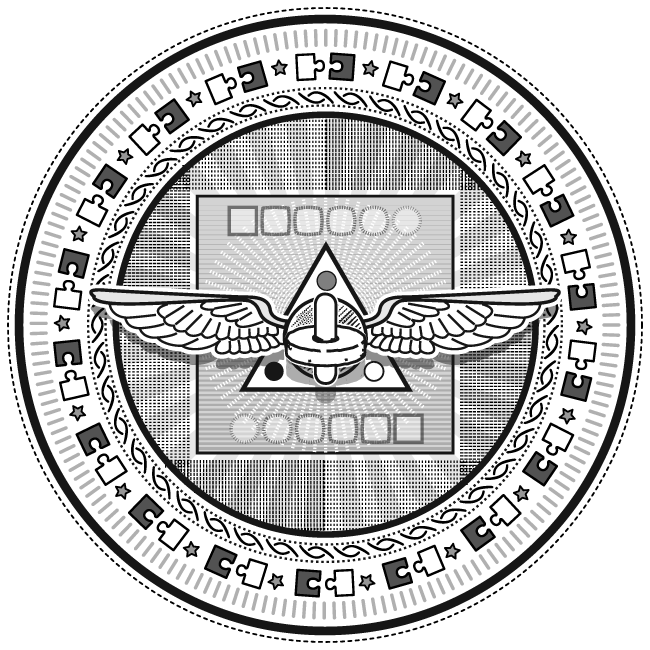
The other day I opened an email from someone who had a quote at the end attributed to Albert Einstein, it read: "Imagination is more important than knowledge." An interesting quote, and... as synchronicity would have it, I was at that very time engaged in a discussion about the relative impact of various modes of thinking. The question being whether information transmitted in clear and obvious ways has as much transformative power as information transmitted in unclear and unobvious ways. In other words, is it demonstrably better to transmit information to another person in straightforward ways or subtle ways. That's not really an excact correlation to Albert's quote, but very similar in the way imagination speaks to the unconscious in subtle ways and knowledge is seen more as something straightforwardly known by the conscious mind.As the quote stands, I'd agree, imagination is probably more important than knowledge, if knowledge is defined as all that a person knows - their bank account of knowing. But if knowledge is defined as clear understanding by the intellect, I would not necessarily agree that imagination is demonstrably better, or more transformative, than knowledge, or the abilities of the intellect to understand. However, it seems that a lot of people in the world of tarot agree with Albert, and argue that information sent in straightforward ways, and received in clear and obvious ways does not have as much transformative power as information sent in subtle ways and received in vague and ambiguous ways.Being vague and ambiguous has its place in the use of tarot, when exploring the unconscious mind. But... when I look at the world of tarot I see such an extreme bias and fanatical reverence for "the subtle" over that of "the straightforward" that it begins to look like an unhealthy extreme in need of some ballast. Vague and ambiguous knowledge of an idea is knowing... knowing of something... something vague and ambiguous, not sure what... but is that really better than actually knowing what? In my own personal pursuit and expression of what I think I "know," I tend to utilize both the "subtle" and "straightforward" approaches. Thus, to me, a balanced and wholly unified perspective is more important than imagination alone or knowledge/intellect alone (sorry Albert). Thus, I would change Albert's quote to say "Imagination is every bit as important as knowledge."The way I see it, living in a world where things are vague and ambiguous will ensure that everything is always magical (which a lot of tarot enthusiasts prefer). But I believe that without a balanced perspective, such an approach will also ensure that one never becomes the Magician, who knows the 'what' of what is what behind the magic. Albert became a Magician, because he combined his imagination with his knowledge/intellect to find meaning. Vagueness and ambiguity are good for establishing interpretive malleability during tarot readings, but... without any clarity, how are we ever to know what it is we think we "know," let alone communicate anything knowable to another person? Ambiguity that is forever ambiguous, is forever ambiguous. Anything that crosses our mind in such a state could be this, could be that... maybe... maybe not... don't really know, can't really say, don't bother asking, doesn't matter, who cares... ambiguity rules. In this state, everything is a surprise of magic... and never anything more.If indirect/subtle communication were as superior as some would like us to believe, why aren't we all mimes, playing charades and guessing what each other means?! Why did we invent written language to communicate? Why don't we all "write" to each other using drawings and photographs instead of words with clear and obvious meaning? How is it that subtle, indirect forms of communication have not won the evolutionary battle of natural selection? Is it because they are not always that clear in what they intend or mean, and thereby lead to unpredictable outcomes that are not necessarily what the communicator wanted, leading to a world of chaos? Why is it that clarity of message and meaning is so popular? Why do so many people want to be understood clearly, rather than not necessarily understood at all? Why would a form of communication that supposedly has very little transformative power be so frequently used by so many?-----Hyped up HolinessThe world of Tarot is clearly dominated by those who think, that imagination is more important than knowledge. They also tend to think that the subtle communication of ideas with symbols is demonstrably better than the straightforward communication of ideas with signs (see Content + Context = Meaning elsewhere on this site). Except that unlike Albert, many in the world of tarot minimize the importance of the straightforward perception of knowledge to such a degree as to create an unhealthy bias. In displaying such a bias, many even go so far as to marginalize and vilify the straightforward approach as wholly unenlightened and worthy of dismissive ridicule or patronizing pity. In cultivating such an environment, the magical world of subtle communication begins to take on an air, not only of superiority, but of sanctimony.I've had many a conversation with many a tarot enthusiast, and in quite a few of those conversations I have felt like I am conversing more with an evangelist of a formal religion than with a simple tarot card enthusiast. Sanctimonious reverence for the magical perspective that follows from a perception of superiority given to the subtle approach and the vague and ambiguous world of interpretive symbols, leads many to accentuate the spiritual aspect of mysteries to an nth degree. Often times the allegorical speech of such "mystics" defies translation. Of course in many circles this is desirable, as many see the secrets they possess as sacred and not something they want just anyone to be able to understand (see The Keys of Understanding elsewhere on this site). To maintain this protective cloak of mystery, some accentuate symbolic ambiguity to such degrees that even they loose their way and begin to wander in their own mysteries, unable to articulate any clear thoughts to themselves or anyone else. When the magic of mystery reaches this point, I tend to think that it is time to take a step back and clear things up (see Imagine a Reason to Believe elsewhere on this site).Because so much of the world of tarot is influenced by the holy sanctimony of hyped up mystery, much of what is to be found on this site is devoted to presenting an alternative view. But in offering an alternative view, this study of tarot does not wish to swing the pendulum to the other extreme and try to argue that the straightforward approach is demonstrably better, or that being clear and obvious is a better way to communicate than being vague and ambiguous. Instead, the alternative that is offered in most places on this site is one of balance between dueling perspectives. However... in the pursuit of balance, it is often necessary to take on an extreme opposite view, just to draw someone with another extremely opposite view more toward the center. It is for this reason that I sometimes ask people if it is possible for them to convey the wisdom they think they are conveying with their vague and ambiguous talk of magic and mystery in more clear and obvious ways. Not because I believe clear and obvious communication is demonstrably better, only that... to be really impressive, one should be able to articulate from either perspective to better demonstrate the validity of an idea as having a universal influence rather than merely reflecting a personal belief or transient emotions.Often I find myself saying to someone that the idea they are relating to me by way of allegory and metaphor steeped in mysterious, hyped up holiness seems very interesting, but can it also be said without all the hyped up holiness and occulted mystery? There are many things in this world that are intrinsically mysterious and don't really need sanctimonious hyped up holiness to make them more important. To me hyped up holiness is evidence of a mind that is taking the magic of mystery to unhealthy extremes. In taking things to unhealthy extremes, the holiness not only distracts from a direct appreciation of what might otherwise be good ideas, but also imposes a cultural bias (in tarot, usually heavily Christian or Hebrew) that also distracts. After filtering through some of these occulted allegories to find the actual ideas, I am usually able to recognize ideas similar to ideas that I have put into the system seen throughout this site, only without so much "holiness." The approach presented on this site is not 100% clear of all references to anything cultural or "holy" (nor do I want them to be) but I try to keep it to an absolute minimum in order for the ideas themselves to be as transcultural as possible (see Cross-cultural vs. TRANS-cultural elsewhere on this site). To me, it is the abstract geometry of ideas juxtaposed against other ideas in the process of building a model of transcultural ideas that is important - not how each idea might affirm faith in, or describe, any particular brand of holiness - whether mainstream or mystical.There is a realm of ambiguity and mystery. It is the realm of the "spiritual." And, it is difficult at times to make any sense of it in clear and obvious ways. It also takes a lot to not fall into the trap of converting ideas with "spiritual" qualities into hyped up holiness that attempts to bolster the faith of a particular culture. And it also take a lot to appreciate abstract, transcultural ideas that do not pander to the psyche in these religious ways. Some ideas are inherently spiritual in tone, even when described in ways that do not favor any specific religion. Other ideas are deliberately crafted to be more religious, or holy, in order to appear more important in the minds of the masses desperately seeking answers, as well as affirming their own culturally specific faith. Cross-cultural, faith-bolstering ideas will always sell more than transcultural, abstract ideas with no bias. But, in many ways, I consider the transcultural, abstract approach to be a bit more pure, and the cross-cultural, faith-bolstering ways to be an embellishment that can at times distract from the purity of an idea.-----Stuck in the MudaphorWhen I use the term "hyped up holiness" it is my intention to suggest a certain level of enthusiasm that wishes to convert any and all mysteries into things deserving of prostrate reverence that takes on a air of sanctimony not unlike that of many organized religions - whether such sanctimony is intended or not.For those who prefer that tarot be solely about the subtle communication of mysteries through vague and ambiguous symbols - things like allegory, metaphor and analogies rule the day. For those who are downright militant about the sanctity of allegory, metaphor and analogy and their superiority in communication over any other method... moving beyond the allegory, metaphor or analogy to reiterate the message of the allegory, metaphor or analogy in clear and obvious language is not only seen as undesirable, sometimes to a point of blasphemy, but also pitiful in how it reveals a mind to be so unenlightened as to think in clear and obvious ways that lack the spirituality of mystery.This sometimes fanatical reverence for, and militant defense of mystery and ambiguity is widespread, and leads to a bias that creates an imbalance that the study of tarot being presented on this site seeks to remedy. As an example of the problem at hand: In reading the book "The Secret Teachings of All Ages" by Many P. Hall, I was reminded, in the chapter on Hermeticism, of Herme's prostrate reverence for a Great Dragon by the name of Poimandres. An allegory, meant to convey spiritual wisdom. In being an allegory, one could argue that it is virtually identical to a tarot card - it is an illustrative embellishment that takes on an air of sanctimony and what - in my opinion - is exaggerated reverence. By cutting through the allegory of Poimandres, I was able to see a few ideas that sounded similar to ideas that appear on this site... except, when I wrote down my ideas, I wrote them down in the most clear and obvious ways I could, instead of inventing a story of someone having a vision of a Great Dragon revealing "The Truth." My preference has usually been to write down my ideas as simple, unembellished, interesting observations of patterns in nature. Ultimately, many of the ideas are similar to those of Hermes, just presented in clear and obvious ways, rather than vague and ambiguous ways.As you can see from all the pages of this site, I try to present ideas using both verbal and visual methods. The words convey ideas in straightforward, clear and obvious ways to the left brain, the diagrams and mandalas convey the same information in subtle, vague and ambiguous ways to the right brain. Within the text itself, I use straightforward descriptions as well as subtle analogies. Some day I might convert my ideas into an imaginative story of a vision handed to me by some Great and Powerful Creature, God or Goddess. But if do that, I will make it absolutely clear that what I am writing is an allegorical illustration of plain and simple patterns in nature that anyone can easily find for themselves.... and then direct the reader to the rest of this site where I try to present those ideas in less allegorical, more obvious ways. Thus, the problem I am pointing to is how things like Hermetics, and other occult institutions of mystery, never do this - they never point us in clear and obvious ways to clear and obvious descriptions of their ideas. Instead, they keep us forever locked in the world of the metaphor, explaining one metaphor with another metaphor, all steeped in vague and ambiguous mystery devoted to hyped up holiness.The chapter on Hermitics that I read ended by stating "The Vision of Hermes, like nearly all of the Hermetic writings, is an allegorical exposition of great philosophic and mystic truths, and its hidden meaning may be comprehended only by those who have been "raised" into the presence of the True Mind." Here again we see this occultist elitism that wants to use hidden meaning to keep the unworthy out. Personally, I say, do away with that, and stop the madness! Nearly all of the Hermetic writings are this way? To me, that is not a good thing. There should a place where the same ideas can be learned in clear and obvious ways that don't suggest that we prostrate ourselves before sanctimonious creatures. The study being presented on this site is an attempt to provide just such a source of knowledge and wisdom. It is an attempt to reveal "the man behind the curtain" who is pulling all the levers that make the Poimandres allegorical puppet work.To be clear... I am not 100% opposed to any and all kinds of allegorical embellishment. After all, I've drawn more than one allegorical tarot deck, and have recently attempted to express some of my ideas as allegorical mandalas and poetic verse. All I am saying is that the straightforward, plain, simple and obvious accounts of these ideas should be as present and accessible as anything used to describe them in allegory or metaphor. And the even bigger point being made here is how people who don't do this, end up STUCK in the world of the allegory, metaphor and analogy, creating a veil of ambiguity, smoke and mirrors, and... more destructively, sanctimony, that makes universal "truths" (if we can call them that) less clear and obvious to the inquiring mind.-----A Balanced PerspectiveAs humans in a world of duality, we argue and debate the merits of opposites. We argue the merits of man and woman. We argue the merits of democrat and republican. We argue the merits of Windows and MacOS. And... we argue the merits of being straightforward vs. being subtle, and whether one method has more transformative power on our psyche than another. Personally I feel as though I have been transformed in both clear and obvious ways as well as vague and ambiguous ways. In my opinion, it is not a matter of one way being demonstrably better than another, only a difference in method between sender and reciever - being clear and obvious hits us right in the face, while being vague and ambiguous sneaks in the back door. Some prefer to be hit right in the face, and don't "get" the vague and ambiguous. Others like to be seduced through the back door of their psyche, and wince at the glare of the clear and obvious. This balanced perspective is clearly evident in the way I've constructed my name numerology (see Name Numerology elsewhere on this site).In my name numerology technique there is a number that gets calculated to represent those things in life that are of clear and obvious interest, as well as a number to indicate our clear and obvious reaction (as in: "I definitely want that"). There is also number to represent things in life that attract our interest in ways that remain forever unclear to us, and a number for our unclear reaction (as in: "I don't know why I just like it"). I call that the "swoon" number, and advise people that if they want to sneak in the back door of a love interest and swoon them, try approaching them in a manner that is characteristic of that particular number. Likewise - in a balanced perspective - if they don't want to swoon someone, but think that a more clear and obvious approach might reach them better, I'd advise approaching them with the other number from the other position.As mentioned above, lots of tarot enthusiasts seem to prefer the back door approach, and will tend to devalue, marginalize or even vilify things that are clear and obvious. In using the tarot to explore the workings of the unconscious through the exercise of imagination, I would agree that shutting out the clear and obvious forms of communication that stimulate the intellect is a good idea. Just like an artist or musician will tap the subtle to stimulate their creative side, the act of interpretation works best when we shut out the intellect. But the question of this essay is not what allows us to interpret tarot cards better, the question is whether there is more transformative power in the subtle than there is in the straightforward. Is the subtle the best way to be transformed or just one way to be transformed? As my name numerology suggest, I tent to suspect that, in being wholly transformed, a balanced dose of both approaches works best, with each one making equally valuable contributions to the end result of understanding - understanding being more transformative than not understanding, or, confusion.There are quite a few spiritual philosophies in the world whose main focus is the ending of suffering. One very common suggestion that many of these philosophies put forth to achieve this goal is to let go of addictions and our naturally possessive nature. Some people are successful at this, while others simply transfer their addictive ways from material addiction to an addiction devoted to achieving the transcendent state that promises to end their suffering. In the process they end up doing what many call "clinging to non-clinging." Clinging to non-clinging is every bit as unhealthy as clinging to anything else. In many ways the often militant objection that people of tarot have for anything clear and obvious could be taken as evidence of people clinging to the vague and ambiguous side of our straightforward vs. subtle duality, causing them to get STUCK in the world of the metaphor. I believe this happens, a LOT!An unbalanced perspective gets stuck, whether stuck in the subtle side or the straightforward side, the vague and ambiguous side or the clear and obvious side. Which is why this study of tarot argues in favor of a synthesis between methods - so as to not be so stuck in our thinking.-----Transformative PowerFor many, learning new information is difficult. For many, allegory, metaphor and analogy help to get information through. This is especially true for children. But... without anyone offering a clear and obvious explanation of what each allegory, metaphor or analogy actually means, what exactly do they learn, something that eventually becomes clear to them, or something that remains vague? Everyone usually gets something from a use of allegory, metaphor and analogy. But, without the combination of whatever it is to be learned, being offered in tandem with the imaginative embellishment of allegory, learning can go astray. That's why lots of fables and stories include a clear and obvious "moral to the story," and why a teacher will discuss the story after it is read, rather than just move on. They want to make sure that what was intended to be learned was actually learned, or more likely to be learned. In the adult world this is called driving home a point. You can introduce a point with the seduction of the subtle approach, but you drive that point home with the power of the straightforward approach.Likewise, in the case of children, they typically have only a tentative grasp of language (not to mention life). Thus, it is not really much of a surprise that using allegories and metaphors with a child would get through more readily than the cold hard realities of life, of which they know so little, and have such little experience processing. But as adults, with an accumulation of experience, things like allegories and metaphors can at times strike us as insulting to our intelligence and our perceived ability to deal with things in more straightforward ways. Often times someone will request that the metaphor be set aside and that things be "spelled out" for them. Whereupon they might finally understand what was only being suggested or implied in the metaphor, and as a result of such improved clarity, have as much or more of a transformative experience as anyone.In fact, this is often the complaint that many have about the overly sanctimonious formal religions and institutions of occult mystery mentioned above, and the allegories, metaphors and parables they use - that they speak to us as if we were children, not capable of understanding things in straightforward ways. Often, when one of the flock tries to translate the metaphor or parable into plain, ordinary, straightforward ideas, they get flack for it, because... (to some anyway) the religious and occult minds, collectively speaking, are STUCK in the world of the metaphor. In a similar manner, I personally think that much of the tarot world, collectively speaking, is STUCK in the world of the metaphor, where subjectively vague and ambiguous interpretation of the subtle is all that matters, to the total unhealthy exclusion of any objectively clear and obvious knowledge of the straightforward, which I, personally, think informs the nature of the subtle in very important ways.As mentioned above, allegories and metaphors might enter more readily through the back door of our psyche, due to our lack of conscious filtration of information. But... as is being suggested here, if they never partner up with a reasoning mind, and get translated into something clear, there is no Ah-ha! of "knowing." Thus it would be my opinion that it is only at the moment when the reasoning mind finishes sculpting the amorphous cloud of ephemeral notions, seductively planted into our brains by way of the subtle, into a concrete thought, that there is ever a transformative Ah-ha! in our minds. And without the Ah-ha! the transformative power of a metaphor is as uninspired as any direct method of straightforward input that does not also do its part to partner up with the subtle nature of our imagination.In this way, I see a kind of crossed symmetry; when we get information delivered directly (LBrain), the first thing we want to do is draw a picture, map or diagram, or to think of an allegory, metaphor or analogy - to visualize it (RBrain). And, conversely, when we get information delivered indirectly (RBrain), the first thing we want to do is bring it up into our conscious mind and translate it into something recognizable and knowable - to verbalize it (i.e. know it, and express that "knowing") (LBrain). Unfortunately, problems arise when direct information can't be visualized, or when indirect information can't be verbalized - i.e. when the verbal person can't visualize and when the visual person can't verbalize. To return to the Einstein quote mentioned at the beginning of this essay, the verbal person who can't visualize will say that obvious knowledge is more important. The visual person who can't verbalize will say that subtle imagination is more important. In both cases, the input or output of information is incomplete, and will undoubtedly suffer from a lack of full transformative power. Lopsided perception on input, or lopsided expression on output will not have the same transformative power as combined perception on input and combined expression on output.Psychoanalysis and Psychotherapy go to great lengths to help us understand our ephemeral notions by bringing them up into our conscious minds for analysis - making the unclear clear, in order to know ourselves better and be transformed. Without this analysis, we walk around with cloudy notions that act upon us in involuntary ways that we never understand. Is this the kind of transformative power that we should admire for being the best, the one detached from our awareness? It's often pretty effective, especially upon those of weak character. Is this what we mean by the superior transformative power of the subtle? Or is it only superior when it partners up with its natural opposite to create a more powerful unity of thought? Personally, I vote for the latter. Even things like a subliminal message, or a hypnotic suggestion are comprised of two things working together - hypnosis, and suggestion or... the message. Without the message, hypnosis alone does not transform as much as hypnosis and a message or suggestion. In this way, the subtle is more like a lubricant that allows the straightforward to slip in and out with ease - a sexual metaphor that points well to the idea being driven home here; that the orgasmic release of transformative power is most intense when opposites work together (see Significant Signature of Nature elsewhere on this site).Those who are militant about the natural superiority of the subtle in acquiring knowledge and wisdom will often go to extremes to make the direct approach sound nearly ineffectual by comparison to the indirect approach. Is this because tarot is so dominantly populated by "subtle" beings who prefer to project their own "subtle" nature onto tarot to such a degree that they totally annihilate the "straightforward" contribution to knowledge, wisdom and insight? Is that why we have such a bias in the world of tarot? Personally, I find it hard to believe that nature is that lopsided in the design of what it has given us. I tend to believe more in the interdependent model, where neither side is "better" but both sides need each other to be anything worthwhile at all (see The Accordionistic Dovetail Joint elsewhere on this site).-----The Lingam and Yoni MandalaThe Divine itself is not lopsided, but nature and humans are, in their imperfect ways. In dealing with nature, we develop right-handedness. But even right-handedness is not lopsided when we consider the underlying symmetry of active and passive working together. Each hand has its own transformative power. Both hands together have the most transformative power. One hand washes the other. It is only lopsided when we do not acknowledge the interdependence of opposites like left and right, or subtle and straightforward, which is what I think happens all too often in the world of tarot.In the mandala below, there is a symbol called the Lingam and Yoni. It is suggestive of the male penis penetrating the female vagina. It is at the center of this mandala to remind us of how the subtle provides a lubricant for the straightforward to enter and exit our minds - the way music carries lyrics into our minds, or helps us sing them back out. The triangle reminds us of how opposites come together to create a third, combined transformative state. The wings are another reiteration of the interdependence idea. In this way, the wings are analogous to our imagination that can cary our knowledge to new heights. Interdependence is illustrated by the fact that wings do not fly by themselves. Imagination is inexorably linked to our body of knowledge and intellect. Imagination alone does not get us off the ground. A body of knowledge alone does not get us off the ground. Our body of knowledge, utilizing the imagination, like a bird flapping its wings, is what gets us off the ground and up to the euphoric transformative state. Thus, imagination is not MORE important that knowledge - as Albert Einstein suggests - it is only every bit as important as knowledge. Which, in a world that often views knowledge as more important, is still saying a lot.
The squares turning into circles represent the crossed symmetry mentioned above, of the verbal trying to visualize and the visual trying to verbalize. And the puzzle pieces reiterate the sexual metaphor or male and female working together to achieve the ecstacy of transformative power.The Lingam and Yoni symbol appears on the Rider/Waite/Smith Chariot tarot card. Many interpreters of tarot point to The Chariot as symbolic of a person who has achieve a mastery of opposites - not a bias that minimizes or marginalizes one side for another, but a MASTERY of opposites - i.e. a balanced perspective. This mandala symbolizes the same thing.-----Togetherness is KEY! ... not War.It is unerstandibly tempting for those with a bias toward seeing "the subtle" as natually superior to that of "the straightforward" to view the intuitive world of interpretation as a realm that should only be inhabited or ruled by the "subtle" people of the world. But as this essay points out, such bias is not healthy. The marriage of opposites is profoundly superior to that of either one working independently. People just tend to forget how much they use and need each method of perception, in order to appreciate them both better. This lack of appreciation is typical of those who are themselves, locked into an unhealthy imbalance of one form of perception over another, which all too often causes them to build resentment toward those who are likewise locked into an opposite and equally unhealthy imbalance, thus leading to exchanges of misunderstanding that cause each one to retreat to the comfort of their own methods and subsequently view their "opponent's" methods as inferior.People tend to go to their strengths. They tend to retreat to what they know, and think it a superior position from which to present a point of view. They also exhibit a tendency to flock together, like birds of a feather. Thus they build institutions devoted to the promoting of one form of perception to the all too often hostile exclusion of another. In the view of many, the world of tarot has become just such an institution... an institution that many view as a sacred sanctuary set aside just for "the subtle" people of the world... a sanctuary that looks down on, closes out, and opposes with great hostility, "the straightforward" people of the world. In this sanctuary, "the subtle" use tarot to accentuate their side of the subtle/straightforward dichotomy, and push away the other, instead of using tarot to learn more about, and become more skilled in, the ways of the other side... in order to use them together.In many instances, these tarot sanctuaries are defended by putting forth, either explicity or implicity, the proposition that being "subtle" is a congenital predisposition that only blesses a certain portion of any population, thus aiding in the establishment of clear lines of distinction to be used in determining who is credible and worthy of inhabiting the sacred sanctuary of superior perception. Exceptions are recognized, but all too often a prejudice is either implicity suggested or explicity expressed that promotes a kind of bigotry against certain types who are either considered congenitally inferior, and therefore incapable, or just unfortunate enough to exhibit "straightforward" tendancies in their presentation of ideas.In other instances, those who wage this war of worlds the strongest are those who were themselves, at one time, less "subtle" and more "straightforward" in their perceptions, and, after "finding" the world of "the subtle" through something like tarot, are so enamoured with the benefits of this other world, that they look back on the "straightforward" world they came from as something undesirable to be discarded and subsequently vilified. Like a junkie high on drugs who never wants to come down, they view their "straightforward" perceptions as a "bummer" to be avoided at all costs. Thus, having joined the ranks of "the subtle" they then take up arms against all intruders who would ever dare to ask them to utilize those "straighforward" skills ever again - something that, in many minds, woud be considered an act of blaspheme! Thus they come to vilify the "straightforward."Please don't be someone who does this.In so defending one form of perception to the hostile exclusion of another, the "subtle" (who tend to take a passive stance) tend to have trouble dealing with the "straightforward" (who tend to take an agressive stance). Thus, "the subtle" tend to feel trampled by "the straightforward." To return to the sexual analogy put forth with the Lingam and Yoni Mandala mentioned above, the unwelcome intrusion of "the straightforward" into these tarot sanctuaries of "the subtle" can at times extend beyond that of being trampled, or even blaspheme, and, in some minds, extend to a point of rape. This can often become the perception of those who devote themselves to the maintenance of a sanctuary of pure "subtle-ness" that tries to keep "the straightforward" out, or worse yet, change the straightforward into something subtle - an uphill battle. Hence their pent-up hostity toward the agressive nature of "the straighforward." But... to those who are able to embrace both subtle and straightforward forms of perception, the interaction of the subtle and the straightforward is not rape... it is a holy union of opposites working together like lovers.
|
![]() |
|
Here is a diagram borrowed from the essay Knowing vs. Psychic Knowing. It illustrates the concept being put forth here about "knowing" coming from a merging of straightforward reckoning and subtle imagining. |
All words and images Copyright © 2008 by Guy Palm
Back to More || Back to Book | Back to Tarot | Home | Site Map| Study of Tarot | Use of Tarot | |||
| Patterns | Structure | Summary | Philosophy | Application |
|
Fun with Fibonacci... |
Spine of Tarot... Evolution of Matrix... Quaternary and Court... Spectrum of Possibilities... Colors... Seasons... |
Key Models... Key Charts... Deck Charts... Deck Layout... Mandalas... Verses... Quintagrams... |
Blind Oracle... Good and Bad... Reasoned Response... Verse 82... The Way... Knowing vs. Psychic... |
Alchemy... Sins and Virtues... Motherhood... Divine Mechnics... Etymology... Dreams... Mudras... |
If you would like to discuss the ideas found on this site, go to: http://groups.yahoo.com/group/TarotAlternative/