Within the confines of the theoretical model of existence being put forth everywhere on this site, there are many interesting patterns and processes to discover. Our theoretical model of existence is, in many ways, a living breathing thing - an entity and an event. It is also, in many ways, a universal thing. In being universal, it promises to be seen as the root cause of every human expression of existence. And... because of how it also proposes a theoretical connection to a divinely inspired state, by way of associations to paradox, our model promises to be seen as the root cause, or source, of some of the more curious and odd expressions of existence.
-----
What If 6 Was 9?
"If 6 was 9" is a famous song title from 60's rock guitarist Jimi Hendrix that... strangely enough, can actually be applied to our theoretical model of existence to describe a very important pattern of nature - a pattern that describes the "invertibility" of our theoretical model, such that its insides can be seen as its outsides and vice versa! Like a reversible jacket that can be worn with either side facing out... or in, our theoretical model of existence can also be turned inside out!
In this visualization of conceptual relationships we will be asked to observe how... within the confines of our theoretical model of existence and its numerically labeled parts, the number 6 equates with the inner circle of existence, and the central point beyond. While directly opposite the 6, we see the number 9 which equates with the outer circle of existence, and the expanse of infinity beyond (see diagram at right). In this way we see how one half of a number line is actually equal to a full numberline! This idea of half a numberline being equal to a full numberline is covered in more detail in the Homing chapter of the book All Things Are Numbers, seen elsewhere on this site. By our understanding of this pattern, we are able to view our theoretical model of existence as a recursive, fractal, endlessly repeating pattern within a pattern (see The Recursive Mandala elsewhere on this site).
When a numberline is conceptualized symmetrically, the point is in the center and radiates out to a sphere in five steps. When a numberline is conceptualized linearly, the point is at one end of a numberline and progresses across to a sphere in nine steps. Either method is equally correct. And... within each of these two numberline expressions, the other will be found. So... as we enter into this conceptual visualization of relationships and juxtapositionings, don't get confused by the ways in which 5 through 9, or 1 through 5, can equal the same thing as 1 through 9. They both express the idea of the point-to-sphere pattern and traversing from the insides of our theoretical model of existence to the outsides... in either 5 or 9 steps.
 |
| Our theoretical model of existence is recursive and fractal. Each half a line is actually a whole line. Our four circles and a point can be used to describe a point to sphere progression in 9 steps, or in 5 steps. |
When a linear numberline progresses, in the manner in which we see it progress in The Geometric Progression shown elsewhere on this site, it can be thought of as ever-increasing, like a universe that is expanding. And... through an acknowledgement of infinite relativity of universal scale, we can see how every point and every sphere are in essence the same (as every point expands to become a sphere and every sphere reduces to just a point). And... because point and sphere are in essence the same, and scale is infinitely relative, we can see how each sphere can in fact be thought of as just another point in a series of augmenting progressions that don't really increase at all, but instead produce a kind of wave or pulse pattern that we see as The Universal Heartbeat of Life (see diagram below).
|
| As a numberline progresses, it can be thought of as ever-increasing, like a universe that is expanding. And... through an acknowledgement of infinite relativity of universal scale, we can see how every point and every sphere are in essence the same (as every point expands to become a sphere and every sphere reduces to just a point). And... because point and sphere are in essence the same, and scale is relative, we can see how each sphere can be thought of a just another point in a series of augmenting progressions that don't really increase, but instead produce a kind of wave or pulse pattern that we see as the heartbeat of life. |
As a linear path, we observe the Heartbeat of the Universe, as every entity and every event pulses with infinite repetitions of this cycle on all levels of the infinitely large and infinitely small. However... as a more symmetrical path, we observe how the same similarities between point and sphere allow for a completely different pattern to emerge. In this new pattern we observe again the fact that within every sphere is a point, and beyond every point is a sphere - making point and sphere essentially the same and thereby strangely interchangeable. When we apply this "sphere-into-point" idea to the 6 and 9 that we use to describe these two conceptual stages of existence when using half of a full numberline, we can see how indeed a 9 can become a 6, just as sure as a sphere can be considered to be a point! Thus... when a point, which we find beyond the 6, and the infinite space, beyond the "sphere of influence" defined by the outer 9, are used to describe the point-to-sphere path, we see, through an acknowledgement of infinite relativity of universal scale, how the concluding 9 - described as an all-encompassing sphere - is reduced... by way of relative scale, back into a point... in order to perpetuate a continuing series of progressions that never end. So the question is... what happens when 9 becomes 6, or... to put it Jimi's way: what if 6 was 9?
The answer to this question is seen, on a human level, whenever we encounter a condition of ironic inversion - where an orientation of meaning that is completely proper in one manner of expression, simultaneously produces a contradictory orientation that is the exact inverse of the previous... leading to an outcome that is ironic. When such ironic inversions occur, it can be difficult at times to judge which orientation of meaning is proper for a given context, and which one should be seen as the contradictory or ironic opposite. And even when the chosen orientation of meaning seems correct, it remains a problem in potentia, as people reading the meaning may, at times, not understand the ironic inversion, and as a result may only see an orientation of meaning that looks wrong. The problems run even deeper when the context of each orientation are seen as equally valid points of view. In such cases things that seem wrong are suddenly seen as correct, simply by changing our inward vs. outward - or "6" vs. "9" perception of context.
-----
Intrinsic Irony
As forms of perception... looking out from inside makes us extrospective, while looking in from outside makes us introspective. When someone looks out from inside, they are at the center of their own universe (6). When someone looks in from the outside, they are at the periphery of that universe (9). When perceptions flip back the other way (i.e. when 9 becomes 6), the form of perception that was peripheral (9) becomes central (6). When perceptions flip back and forth in this way, orientations between conflicting levels of context produce ironic inversions.
|
| When I am the center of my own universe, others are elements of that universe which are found outside. When someone else is the center of their universe, I am an element of that universe which is found outside. Inside becomes outside. When I am extrospective, I am at the center (6)... inside looking out... at a sphere (9). When I am introspective I am at the periphery (9)... outside looking in... at a point (6). 6 becomes 9! |
Extrospective perception and introspective perception are two of most common forms of conflicting perception known to exist. Coined as Extroversion and Introversion by Carl Jung, many people use this dichotomy of perception as a primary tool for sorting people into psychological categories of types. And while any mind is capable of switching between these two forms of perception, people are often classified as being dominantly, or intrinsically, one type or another. In many societies around the world extrospective extroverts out-populate the introspective introverts. Acknowledgement of this fact leads many spiritual philosophies to recommend detachment as a primary tool for enlightenment. Being stuck inside looking out causes people to make assumptions about the universe they see themselves the center of, which leads to egocentric thinking and a clinging to the core that holds all that together. As a way of seeing the errors of this form of perception, people are often asked to detach and look inward for a change. People who are always looking outward tend to look for answers to spiritual questions in the things of the universe that are outside them. This often leads to idol worship and a subsequent diminishing of ones own self worth relative to some external object of worship. In an attempt to show an alternative method, many spiritual philosophies recommend looking inward for a change, to find our true self, and see that as something worthy of worship. This idea of leaving the self in order to better understand the self is itself an ironic inversion. That we need to be outside looking in, in order to find our center, from which we are already in... looking out, is intrinsically ironic.
Another dichotomy of perception used to classify people into types is the dichotomy between left-brained thinking and right-brained thinking. Left and right brained thinking is not of the same class as inward and outward thinking, but they do show how our human bodies incorporate irony intrinsically into our form. The fact that the left side of our brain controls the right side of our body and the right side of our brain controls the left side of our body is itself intrinsically ironic. The fact that this inversion occurs between our brain, which is on our insides, and our limbs and eyes etc., which are on our outsides does make this form of irony relevant to the inward vs. outward dichotomy just discussed. This kind of ironic inversion makes it difficult to define true left and true right, when attempting to orient one context of our world to another. One needs to know whether a particular orientation has been determined by the perceptions of our inside or our outside... our brain or body... our extrospective or introspective perceptions.
The kind of crossing over just described can be seen in the design of our theoretical model of existence, using models like the Apart-Together model and the Chopstix model found elsewhere around this site. In these models we describe the four stages of our theoretical model with opposites converging upon a center, where... upon converging, those opposites fuse and twist in such a way as to cause a complete swapping of sides. Twisting is what enables our two sided universe to be one sided, like a Möbius strip.
-----
What Color Is Your Rainbow?
One place where the problem of ironic inversion and dueling context can be seen explicitly is when we try to decide how to orient the colors of the visible light spectrum with the stages of our theoretical model of existence. Scientifically... we should think about matching the intensity of the coagulated core of existence with the most intense and tightly packed wavelengths of light - the ones adjacent to Gamma Rays. Likewise, as intensity diminishes at the periphery, such relaxing of force should be matched up with the slower, longer wavelengths of light. This scientific orientation would put the violet/blue end of the spectrum at the interior of our model, and the orange/scarlet end at the outside of our model. But... in another context - an aesthetic context - that orientation seems completely wrong. Aesthetically, when we compare our theoretical model of existence to a planet or a star in space, we would want the hot fiery colors of orange and scarlet to be oriented with the hot and fiery appearance of the core, as it represents a molten mass of coagulated matter. While the cool colors of violet and blue would work well to describe the diminishing intensity of that heat back into the reaches of the frozen darkness of surrounding space.
I encountered this very problem when attempting to orient the visible light spectrum to the stages of the theoretical model of existence being presented everywhere on this site (see Enjoy The Pretty Colors and A Crazy Quilt elsewhere on this site). This problem appeared again when trying to orient colors to sounds in my creation of a nine tone musical scale (see Music elsewhere on this site). In the case of music, most people associate low frequency sounds with low frequency colors. But when I did this, with an ascending musical scale, the association of colors to numbers came out inverted from that of previous orientations. My solution to this problem was, and is, to use both orientations in whatever context seemed appropriate. With this approach in mind, I used the scientific orientation to describe the augmenting intensity of an individual number line, with the orange and scarlet colors coinciding with the orgasmic release that defines the end of each numerical cycle, while using the aesthetic orientation to describe the idea of a coagulated core of matter heating up like a star or molten planet. It also makes more sense in the orientation of musical notes to the number line to have warm colors at the beginning and cool colors at the end of a number line. With warm colors and the beginning and cool colors at the end, the low notes that go with those warm colors can coincide with the idea of the 1 through 4 half of the numberline as male, and the 6 through 9 half as female, thereby designating low tones as the male voice and high tones as the female voice of any octave or range of octaves. Given the dual nature of any number line, and its ability to be seen in both linear and equidistant ways - as put forth many places around this site - these orientations seem highly appropriate. Not that science is strictly linear! But the literal nature of the linear form of progress versus the more conceptual nature of the equidistant design seemed to lend itself to these two different forms of orientation.
 |
| If we try to keep a spectrum of colors consistent, different kinds of numberlines become inversely oriented to each other... causing one line's declared insides to equate with another line's declared outsides. When this type of orientation occurs we can effectively say that 6 has indeed become 9! In the diagram above the Geometric Progression associates a small number with the smallness of a point and the smallness of wavelength associated with the color Violet. It puts this beginning point at the insides of our theoretical model of existence, ending on the outside with a larger sphere. In the upside down progression the Musical Progression associates a low number with a low musical tone and the low frequency associated with the color Scarlet. It puts these warm tone at the insides of our theoretical model of existence, where we find the hot molten core, and lets the sounds increase in tone with the numbers. If we keep the colors moving in one direction, the increasing numbers need to run in opposite directions - 6 becomes 9, and our world is turned upside down! |
 |
| If we combine opposite types of numberlines so that their numbers correlate and they both have the same orientation of inside and outside, we observe an ironic inversion of colors from one end to the another. Both of these options make any definitive declaration of colors to numbers impossible without irony. Each orientation is conditional and dependent upon how we choose to describe the insides vs. outsides of our theoretical model of existence. |
But... even with these decisions of orientation made, one could still argue that the proper way to describe a coagulated core of existence is with the scientific context, which... when comparing our model with a planetary analogy - would put the violet/blue colors with the fiery molten core, and the orange/scarlet colors with the cold reaches of space. To some, that would be ironic. That would - in at least one manner of looking at things - turn things inside out! From there, one could argue that such an orientation would be like making a 9 into a 6, or... a sphere into a point!
-----
The 6 Is 9 Mandala
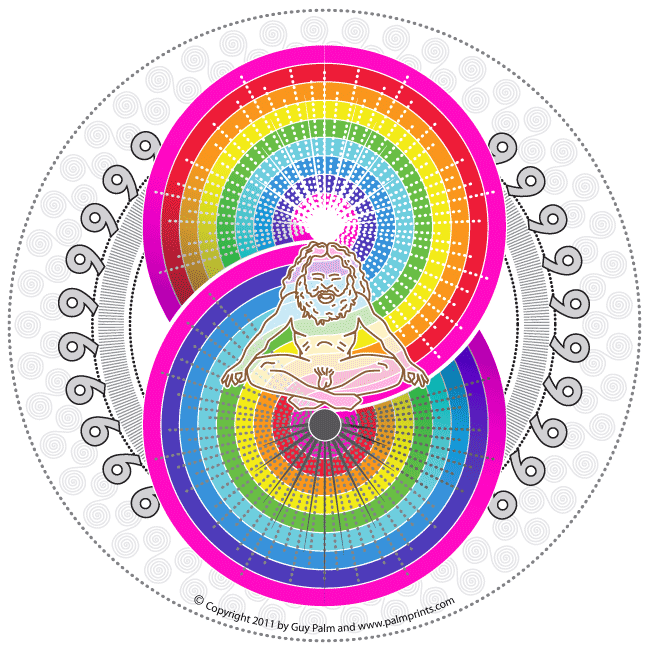
Here is a mandala we can use to remind us that orientation of colors to our theoretical model of existence is conditional. Like a reversible jacket, we can wear either of two orientations and always be correct!.
 |
| In this mandala/diagram small wavelengths are intense and powerful - perfect for describing the nature of our core of existence. Warm colors are also perfect for describing the heat of a warm body or core of a planet in space. But small wavelengths produce cool colors. That's ironic. Making any association of color to our theoretical model of existence destined for contradiction. |
This mandala shows a meditating person spanning the two centers of existence. Two centers of existence? Yes, because of theories put forth all around this study of consciousness and the cosmos concerning the paradoxically binary nature of singularity, we see how these two centers are in fact portals to each other... as they are ultimately the same place. Beyond the infinitely large and beyond the infinitely small is a place of singularity. Because our manifest existence divides this place into two locations (beyond the infinitely large and the infinitely small) it is a singularity that is paradoxically binary or split in two. By defining this otherwise ineffable state with paradox we locate a theoretical source for making our universe invertible! Elsewhere we use the topographical paradox of a Möbius strip as a visual analogy for how paradox impossibly unites two into one, while at the same time, being one that is made from two - just like the singularity that is split by our manifest universe. The winding path of the 6 is 9 mandala is not quite the same as a Möbius strip, but... the way the two color schemes are both opposite and yet united as one is very similar. And just as untwisting the part of a Möbius that is twisted only causes the untwisted part to become twisted, reversing the order of either end of the rainbow path would only cause the other end to become its opposite - 6 would become 9! and our world would be upside down, but still the same, relative to either end. Given time, we would get used to a 9 that is now a 6 and things wouldn't be upside down at all, just ironically inverted. Until someone comes along and reverses things again!
-----
The Inverse Universe
In the minds of most people, ironic inversions, like the one just described, are problems in need of a solution. The desire for certainty that pervades most minds would compel them toward a single solution, rather than a binary solution that is relative to a context of perception that could invert itself at any moment. Turning things inside out, like a reversible jacket that can be worn either way, is not a solution that most people would find comforting. But... because of our theories about the invertible nature of a point and sphere, and the idea of an Absentia that unites them in form, we have a model before us that can actually be turned inside out - just like a reversible jacket! In other words, when we change a 9 into a 6, or a sphere into a point, we are not just continuing on along a linear path - as our numberline diagrams might imply. We are in fact turning our universe inside out and heading back out from an inner central point that used to be an outer enclosing sphere!!! Or... if considered from the other direction - the direction used to describe the original idea of coagulation from nothing into something in the book All Things Are Numbers (seen elsewhere on this site) our arrival at a finite inner point would lead to an infinite outer sphere, and an endless fractal act of inward coagulation, rather than outward emanation.
This idea of arriving at a center and having it flip, like a 6 turning into a 9, into an outer sphere... from which we continue an endless inward journey toward another point... that becomes a sphere... from which we continue an endless inward journey... is the functioning effect of The Absentia. Elsewhere we define The Absentia as a place with no place... beyond the infinitely large and beyond the infinitely small... with the universe if vibrations between. In this way we conceived of The Absentia as a singularity that is paradoxically split by an intervening universe into two locationless locations... creating a singularity that is binary!! But... with this reversible universe idea in hand, we can see how the singularity of The Absentia can also be thought of as singular point of singularity. With reversibility the absentia is no longer split between infinitely large and small, but is now a singular point... with a universe flipping back and forth across it. When our universe arrives at a point, it inverts it into a sphere and continues on infinitely small. When our universe arrives at a sphere, in inverts it into a point and continues on infinitely large. The point at which this critical flip takes place is... The Absentia.
Endlessly inward as manifestation coagulating into a black hole, or endlessly outward as energy radiating out into an expanding universe. That is the "Solve et Coagula" nature of our theoretical model of existence (see The Law of Coagulation within the book All Things Are Numbers elsewhere on this site). And as this condition of inverse reversibility is allowed to exists, it becomes the archetypally rooted source of all the irony that we experience in our human lives. When we view our theoretical model of existence as an axial system of archetypal crystallography, this inward vs. outward direction of orientation plays a crucial role in determining the more or less ironic nature of any entity/event we experience.
-----
The Source of Irony
When our universe gets inverted, we perceive irony. But, in order for anything to invert we have to acknowledge opposites. In a world that acknowledges opposites, irony is just one result of binary interaction. As the two halves of our binary minds fight over which perspective is "correct" or the best one to utilize for any given situation, interactions of all kinds take place (see The Binary Buddy elsewhere on this site). As avenues of perception the study of consciousness being presented everywhere on this site uses fundamental directions of orientation as a guide. As pairs of opposites, fundamental directions of orientation carry with them certain qualities of character analogous to the functioning of the human mind that allow us to define fundamental avenues of perception that are universally inspired. These fundamental qualities are put forth succinctly in the essay Numbers In Space and utilized to great advantage by The Binary Influence Calculator and The Dream Analysis Calculator found within the essay The Dream Analysis Calculator.
Opposites are usually not very static. In most cases, each opposite wants to be what the other one is. Like two mirrors facing each other in infinite repeat each one has something of the other in it. But when they interact with each other, they don't all create ironic inversion. In some cases it is more of a tug-o-war. As defined by our Dream Analysis Calculator, the direction of Up vs. Down produces a dichotomy that is much more segregated in that they represent a kind of fork in the road that increases or decreases our path. Going one way instead of the other will reverse the other, but not invert it. Front and Back are also more segregated in the way they represent a cause and effect, or before and after relationship. With an implied arrow of time in effect these two never meet. Every effect has its cause, but the cause is not the inverse of the effect. Left and Right produce a dichotomy of perception equivalent to left vs. right brain functioning. Going one way instead of the other will chop reality up into pieces or fuse it into a whole, but will not invert it. Active and Passive, or Yes and No are also more segregated in the way they represent the incompatible choice to move or not. If we include the idea of Good vs. Bad as yet another fundamental form of perception, it too has a degree of segregation to its sides. However... unlike the other 5 opposites of G/B, U/D, L/R, F/B and Y/N, which are segregated opposites, In and Out traverse the same theoretical ground, just in opposite directions between inside and outside. So the battle between sides isn't so much a linear tug-o-war or fork in the road as it is a complete inverting of totality inside out, or outside in.
As opposites battle each other, the point where they meet creates different kinds of dichotomies that can at times baffle the mind. In the book All Things Are Numbers a study of paradox showed how paradox itself can come in various forms that are reminiscent of the degree of separation seen in the Apart/Together model - a model that reproduces the four stages of our theoretical model of existence as degrees of separation or proxemics (see Why Abstract Patterns elsewhere on this site). Not all points of juncture between opposites lead to paradox, sometimes they just produce dichotomies that are in subtle conflict, producing quirky states of being. In the case of Left and Right, the idea of metaphor is born, where one state is used to describe the other. While Up and Down produce an incompatible oxymoronic state. Leaving Front and Back to produce a kind of cyclical question and answer state where answers lead to questions. While Good and Bad produce an indeterminable trash vs. treasure state. Leaving In and Out, and its inverted path of simultaneous traverse, as the source of irony.
Because sides gravitate toward each other, our insides are always looking, and moving, out... and our insides are always looking, and moving, in. Having to be outside in order to be introspective or introverted, or inside in order to be extrospective or extroverted is itself an ironic state of inverted symmetry. Inverted, or inverse symmetries are common. And with our theoretical model of existence, we can theorize a source, or reason for such dichotomies to exists in our human perceptions. As humans, people tend to assert their independence (ME) when they are in a group (WE) inside. Likewise, in inverse symmetry, people tend to realize their interdependence (WE) when they are left alone (ME) outside. When I am the center of my universe, you are outside. When you are the center of your universe, I am outside. The 6 is 9 Mandala, shown above, illustrates how both states of existence can co-exist in both independent and interdependent ways, depending on how we choose to shift our perceptions. |