What is an archetype? I don't know. Some people look at an iconic illustration on a tarot card and call it an archetype. Others describe an archetype as something more ethereal and transcendental.
In describing an archetype as something ethereal and transcendental, many see descriptions (even symbolic ones) as inadequate, or even destructive to the "true" nature of an archetype. In this way, the intangible, ethereal and transcendental nature of an archetype resembles a quantum wave cloud of probability that some people don't ever want to see collapsed into a particle point of certainty by human perception or explanation (see The Totality of Reality and The Keys of Understanding elsewhere on this site). Those who prefer things to remain undefined suggest that the true nature of an archetype can and should be known and understood only through intuition and intuitive "knowing." They will typically offer no answers to the question of what an archetype is, beyond "You'll know it by its energy" or "Some things just resonate as true." For those who find this to be a satisfactory answer, by all means, do not bother to read any further.
Lots of things are hard to communicate. And some things do loose a bit of their luster when explained. But that doesn't stop people from trying. What is LOVE? What is ART? What is LIFE? What is REALITY? Lots of people go on and on about ethereal, transcendental things. They don't just give up, because it is an elusive concept that is hard to communicate. Like subatomic particles that can't be seen, some concepts are impossible to define. But (in my opinion) theoretical models can be designed and built to visually represent the abstract conceptual patterns that form in the Minds of people when attempting to comprehend invisible ideas - i.e. the theoretical abstract juxtapositioning of one invisible idea against another etc, etc. Those models will have their own bias, being obvious manifestations of invisible ideas, but nevertheless, could serve well to communicating an elusive idea from one Mind to another... as well as across cultures and time. They could certainly do more to advance the cause of communicating an elusive idea from one Mind to another than simply saying to someone that they will know the energy of something when they encounter it.
Anybody can say they "know" something is what they think it is. And by pointing out the ineffable nature of some things and how some things can't be known any other way than individual "knowing," they can avoid any obligation to explain how they know what they say they know, thus leaving us all to either believe they really know something... or not. The fabric of belief is thin and fragile, and because of the blind obedience of otheres, to those who claim to "know," a thin veil of fabric is often all that is needed to hide superstitions and falacious assertions. People believing what they know, without ever bringing to bear a critical eye of examination, are susceptible to delusions of grandeur. People who are taught to believe, without ever bringing to bear a critical eye of examination, are susceptible to abuse.
|
Religion says: Believe and you will understand. Science says: Understand and you will believe.
|
A critical eyes is necessary, to pull aside the veil of ignorant belief and see things for what they are. Personally, I like how people in spy or crime movies use smoke to "see" the invisible patterns created by the laser beams of a burglar alarm system crisscrossing a room. By introducing smoke - analogous here to a critical eye - the crisscrossing laser beams become an invisible pattern... clothed in smoke. The smoke is not part of the pattern, but it is one way of "seeing" invisible patterns. The point being, that we don't have to give up, just because patterns are invisible. We can choose to look deeper. When someone says I'll just know, or that some things just resonate, I can apply that to many things. In my life, I've had many strong feelings that impress, influence and fascinate me. I've had vivid visions of archetypes and episodes of knowing and resonance. I still do. And everything I do as an artist is an effort to show what I saw... and still see. Sharing is good. So I try to show what I see.
-----
Emotional Affinity
People who attempt to enlighten others as to the nature of archetypes, by suggesting that "knowing" and "resonance" should be employed, propose that a strong sense of emotional affinity is at work when we encounter something that gives us that resonance. In examining this approach, I would agree that emotional affinity plays an important role in identifying, or "knowing" the influence of an archetype. I myself have had such feelings of emotional affinity and knowing. But, at the same time... I've had deeply felt feelings about a lot of things. The question concerning archetypes is; how do we differentiate between emotional affinity that is devoted to the expression of individual taste or personality, vs. connecting to an archetype? When examining the icons of tarot, a person might connect to one card because they see themself in it... it resonates with them, because - in their eyes - it is them. They may find that the rest of the cards don't resonate as much, or at all. Does that mean they are only able to connect to one archetype? Maybe, for someone else, the only card that resonates with them is the Star card, because it has a naked woman, and they like to ogle naked women... that resonates with them as something that is "true." It might even give them goose bumps... or something else! Are they connecting to an archetype? Is every deep emotional feeling evidence of an archetype?
We don't all have the same reactions of resonance, so how do we "know" what an archetype is? In the world of "knowing" things, meaning is personal. Without explanation, a custom built reality is created that answers all questions in personal terms that never fail to satisfy. Nothing is ever anything other that what the individual wants it to be whenever they want it to be that (see Content + Context = Meaning elsewhere on this site). By closing out social reality, personal reality rules, and we intuitively "know" everything. But without periodic sharing of our personal reality, we contribute nothing to the construction of a social reality, and we run the risk of becoming deluded into thinking that our personal reality is in fact everyone's reality. This is how many come to the erroneous conclusion that symbolism is a universal language of universally understood imagery that everyone just "knows" (see The Keys of Understanding elsewhere on this site).
-----
Peer Review
The importance of sharing a vision reminds me of the movie "Close Encounters of the Third Kind", where a bunch of people have had this vision of Devil's Tower planted into their brains by aliens from outer space. None of them know what Devil's Tower is, but they feel compelled to understand the "vision" that has been given to them. One person is shown drawing sketch after sketch after sketch, trying to find the perfect expression of this vision. The hero of the story isn't even an artist, and takes to sculpting the vision in his living room. None of them know that there are others who share the vision. If they had known and shared those artistic expressions, they might have found some comfort in knowing that someone else's "knowing" is the same as theirs. Sharing is good, it helps.
There is also a scene in that movie about "knowing" where our hero is on the verge of loosing his mind, trying to express this vision. He tries to get back to normal and have dinner with the family. But piles of mashed potatoes remind him of the vision. So he begins to sculpt the potatoes. As his bemused family looks on, he apologizes for his apparent insanity, and mumbles something like "This means something, I "know" this is important."
Goose bumps are a good indicator of "knowing." But without periodic affirmation from an external realtiy, "knowing" can easily become superstition. See The Totality of Reality elsewhere on this site. People who are extremely left-brained, and not know for their artistic recognition of shapes and visual play or conceptual thinking and abstract connecting are often overwhelmed when the "vision" of Jesus appears to them in a piece of burnt toast, or when they see The Virgin Mary in the stains on a wall. When left-brained people are thrust into their visual right-brain by the recognition of an image with such spiritual significance, they can easily delude themselves into thinking it is a miracle and a Vision sent to them from God. Without peer review, such delusions persist.
-----
Inherited Influence
Sharing our "knowing" is not easy. Explaining is draining, in more ways than one! By explaining, we give form to the formless so that one or more of the five senses, found within another individual with whom we hope to communicate, can sense what we sense, and thereby have some chance (however slim) of knowing what we think we know. The theoretical model of existence being put forth on this site is extremely abstract, but still, it exists. In that way, it is more than just my "knowing" - it is something for the five senses of others to examine, so that they might have some chance (however slim) of knowing what I think I know.
The deeply felt feelings, utilized by the emotional affinity path to archetypal "knowing," come from somewhere. We don't have to ask where, we can just "know" them, and never explain anything to anyone. But... if we do ask where... then where? For me, a person who is trying to explain what it is I think I "know"... the answer is PATTERNS. To me, abstract patterns and geometrically juxtaposed concepts and ideas that create or mimic fundamental, elemental, primordial, transcendental patterns are a tool of archetypal communication. Through its abstract patterns, the theoretical model of existence being put forth on this site attempts to describe a universal blueprint of archetypal essence from which archetypal "knowing" evolves.
Many argue that all we can ever know of anything is reduced to electrical impulses in a Brain. That's probably true, but there is a difference between Brain and Mind. To a Brain, reality equals electrical impulses. However, to a Mind, reality equals patterns of electrical impulses (see The Totality of Reality elsewhere on this site). From patterns... anthropomorphized by humans, iconic representations of archetypal influence evolve into illustrations on little pieces of paper as tarot cards. From patterns... human behavior is shaped and archetypal influences evolve into the personality types seen by psychotherapists. The influence of archetypes is inherited from a divine source. Archetypal essence is transcendental. In that way, it influences everything! The influence of archetypes - or archetypal essence - is projected from its amorphous source into the finite world of the living, as a universal blueprint upon which all existence is constructed, and, to which all existence connects, through the emotional affinity path of "knowing."
-----
Two Paths of Knowing
When people with an interest in sculpting marble, or any other subtractive medium, are asked to explain that highly intuitive art, they often describe the figure that results as being hidden with the block of marble, and their job as a sculptor is to find that image and set it free. In this way, the transcendental influence of archetypal essence is given life - even within a block of marble. This would be analogous to the Emotional Affinity path of knowing where archetypal essence is found by connecting back to an inward source.
To those with an interest in sculpting with clay, or any other additive medium, the importance of an armature is obvious. When asked to explain this highly intuitive art, they will explain the importance of the armature in defining the transcendental essence of the figure, and how it is there job as a sculptor to build out, layer upon layer, to a perfect expression of the archetypal influence that is being projected from the amorphous world of the Divine. This woud be analogous to the Inherited Influence path of knowing, where archetypal essence is projected out from a source.
"The archetypes are the numinous, structural elements of the psyche and possess a certain autonomy and specific energy which enables them to attract, out of the conscious mind, those contents which are best suited to themselves." - Carl Jung.
Like an armature attracts the clay of the artist, there is a structure to archetypal influence that can be understood. The theoretical model of existence being put forth on this site is intended to be just such an archetypal armature, crafted from primordial patterns that point to the transcendental essence of "knowing." We can connect to these patterns through emotional affinity, and whichever of them resonate with our personality, or we can build upon the inherited influence of each of them as they project their influence into the tangible world of human expressions (see The Totality of Reality elsewhere on this site).
-----
An Archetypal Equation
Some will argue that not every human mind needs to label things in order to contemplate their true nature. I would agree, a mind does not need to label things in order to contemplate their true nature... if that is all someone ever wants to do. A mind that personalizes and internalizes everything without ever confronting the need to explain what it is that is in their head in ways that other people can understand will probably never need to label anything... ever... in any way at all. But... if we want to share what we think we "know" in all its complexity, we might find a need to break things down into digestible portions, using language and labels that differentiate one thing from another - unless, of course, we can figure out that Vulcan mind-meld thing!
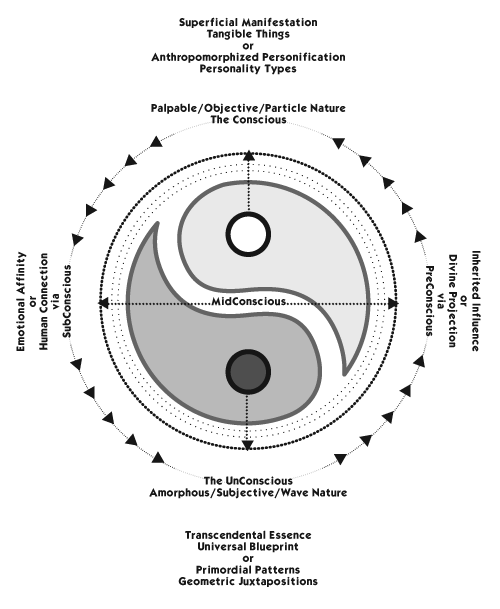
Here is a chart I made, to help visualize the paths of "knowing" that tell us what an archetype "is." This is how I "know" an archetype. Like a subatomic, quantum wave form, we collapse the amorphous into the palpable through examination, exploration, manifestation, explanation and personification of transcendental essence. Expression alters essence, and in its place, builds a social reality of signs, symbols, icons and personality types (see The Semiotic Equation and The Keys of Understaning elsewhere on this site).
 |
|
Like a subatomic, quantum wave form, we collapse the amorphous into the palpable through examination, exploration, manifestation and personification of transcendental essence.
|
In the Archetypal Equation chart, we describe, or define an archetype as:
1) Archetypes = Emotional Affinity. Deeply felt emotions lead to recognition of archetypal influence. A preference for personalization and internalization plays a big part in the acceptance of this idea. In the world of personalization and internalization, we just "know" an archetype, and there is no need to explain what we "know" to anyone but ourself.
2) Archetypes = Inherited Influence. Archetypes evolve into manifest things through levels of abstraction. And all manifest things carry forward archetypal influence into the world of expression. On this path, a mind capable of connecting abstract notions to objective realities is helpful. This requires an acknowledgement of an objective social reality.
We also see how:
3) Archetypes = Human behavior. Personality types are the embodiment of archetypal influence. The character of people is determined by archetypal influences. This may be a limited application of the term, but probably popular enough to make some people think that this is all there is to an archetype. In this world, archetypes are human characters, whether drawn on a tarot card, or performing on a stage, or bumping into us on the street.
The Emotional Affinity and Human Behavior camps use frequency of occurrence, within or across cultures, as a means of finding agreement about what they think they "know." The Inherited Influence camp uses logic and theory to suggest grounds for understanding, based on an evolution of ideas from a foundation of definitive, primordial, transcendental patterns.
The Emotional Affinity camp suggests that even bad emotions can lead to archetypes. If that notion were adopted by the Human Behavior camp, then perhaps even stereotypes would be seen as characters derived from archetypal influence. And I don't see how either one of those camps would suffer from associating themselves with the Inherited Influence camp. For more on the idea of stereotypes having archetypal influence, read the essay Archetype or Stereotype? elsewhere on this site.
-----
An Archetypal Acronym
This is how I define an archetype; with two paths to understanding. In my world, an archetype is NOT the image, or the icon, or the personality type. An archetype is the transcendental essence, which I personally choose to "know" by way of a Universal Blueprint of Primordial Patterns. The details of that Universal Blueprint of Primordial Patterns can be found throughout the pages of this site. However I acknowledge that, to many, the image, icon, or personality type is the archetype. For those who insist on calling these manifest entities an archetype, I offer this acronym to help remember that there is more to archetypal "knowing" than what appears in front of our eyes.
If one wants to call the image they see on a tarot card an archetype, they should at least be aware of the transcendental essense behind the image. That is, in fact, what this entire web site, book and deck are about - the archetypal armature that describes the "structural elements of the psyche."
-----
Universal Archetypes
People who think the images on the cards are archetypes will occasionally put forth the argument that those archetypes - and the signs, symbols, icons and other imagery that define them - are universal symbols extracted from a collective unconscious of universally understood imagery seen across cultures and time and intuitively understood by anyone. At the same time... those same people will just as often argue against defining symbols in any universal way, because of how it destroys the creative malleability of subjective interpretation, imagination and intuition.
The nature of this conflict can be traced to the problem of private personalization vs. public discourse. The nature of this conflict, as it pertains to private personalization vs. public discourse, can be examined in detail within the essay Content + Context = Meaning and its comparison of signs vs. symbols. The nature of this conflict as it pertains to the universal nature of signs and symbols can be examined in detail within the essay The Keys of Understanding.
| The image is NOT the archetype ! |
Ultimately, the All Things Are Numbers approach says that there are such things as universal archetypes, but there is no such thing as universal symbols or universal signs. There are many ways to "clothe" the "Invisible Man" of ideas that are infinitely drawn nowhere (if one chooses to do more than just "know"). The model on this site is one way. As an outgrowth of the model, the icons of The Numerical Tarot, and the Isomorphic Tarot - and any other deck I might draw in the future - are all Anthropomorphized Representational Characterizations of Human Existence and Transcendental Yantras of Personified Essence. They are not archetypes, but they play them in a tarot deck!
-----
The Cloud to Rock Mandala
Here is a mandala that can be used to meditate on the idea of transcendental influence projecting out into the world of the manifest to become anthropomorphized representations created by humans to "see" the archetypal patterns... as well as the emotional affinity that connects us to those patterns. At the center is a pool of water, symbolic of the unconscious, with ripples radiating out from opposing sides, symbolic of the two way street of archetypal "knowing" - Projected Influence vs. Emotional Affinity. Around the square pool of water is a morphing circle where Rock becomes Cloud... or Cloud becomes Rock. This mandala, and the design of human understanding about archetypal influence that it tries to represent, advocates an adherence to balance and the idea of keeping ones head in the clouds and ones feet on the ground. Many people get carried away by the transcendental nature of archetypal influence, and how the Emotional Affinity path connects us to the divine nature of primordial patterns. In devotion to this seemingly magical state, some begin to look back on manifest existence with revulsion. This mandala, and the Archetypal Equation discussed above, hopes to illustrate, and remind us, to honor both sides of any issue. Bathe in the center of the manifest pool of the conscious and subconscious mind.
 |
|
We turn to archetypes, like a plant turns to the sun.
|
Radiating down from the cloud are rays of sunlight, or drops of rain - take your pick. Growing up from the ground are blades of grass. This again, repeats the idea of the two way path of archetypal influence or archetypal "knowing"... the sun sends us its energy (Inherited Influence, Projecting), we then use that energy, like a blade of grass, to reach back to that source of energy (Connection via Emotional Affinity). We turn to archetypes, like a plant turns to the sun. The metamorphic transition of tadpole to frog and caterpillar to butterfly also speaks to this two way path. Tadpole goes from water (unconscious) to land (conscious). Caterpillar goes from land (conscious) to sky (unconscious).
Around the Cloud-Rock morphing circle are two ropes twined together midway between top and bottom. This is symbolic of how the two paths of archetypal knowing sort of tug-o-war within us as we struggle to keep both head in the clouds and feet on the ground. The knots symbolize how things work best when opposites are married and given equal respect for what each brings to the table. The rope is the string of a kite that connects us (on the ground) to the divine (in the clouds). The diagonal lines of the rope create a directional bias around the perimeter, that reminds us of how the two paths of archetypal knowing are cyclical and feed each other. The kite on the string elevates us, the string attached to our hand, grounds us.
Archetyal influence is projected, as an expression of the structure of transcendental patterns into the world. The rock is the transcendental patterns, after acknowledgement by humans. The rock is also the anthropomorphized iconic and symbolic representations of the patterns by humans, used as a language of limited meaning. The cloud is the transcendental patterns, before acknowledgement by humans. The cloud is also the anthropomorphized iconic and symbolic representations freely interpreted by a mind to mean any number of things.
Quantum clouds of probability become particles of reality that enter the mind as an illusion of perception. Look at the cloud and turn it into reality. Don't look at reality and live in the cloud. Square the circle. Round the square. Each has a purpose. Live in the middle.
|